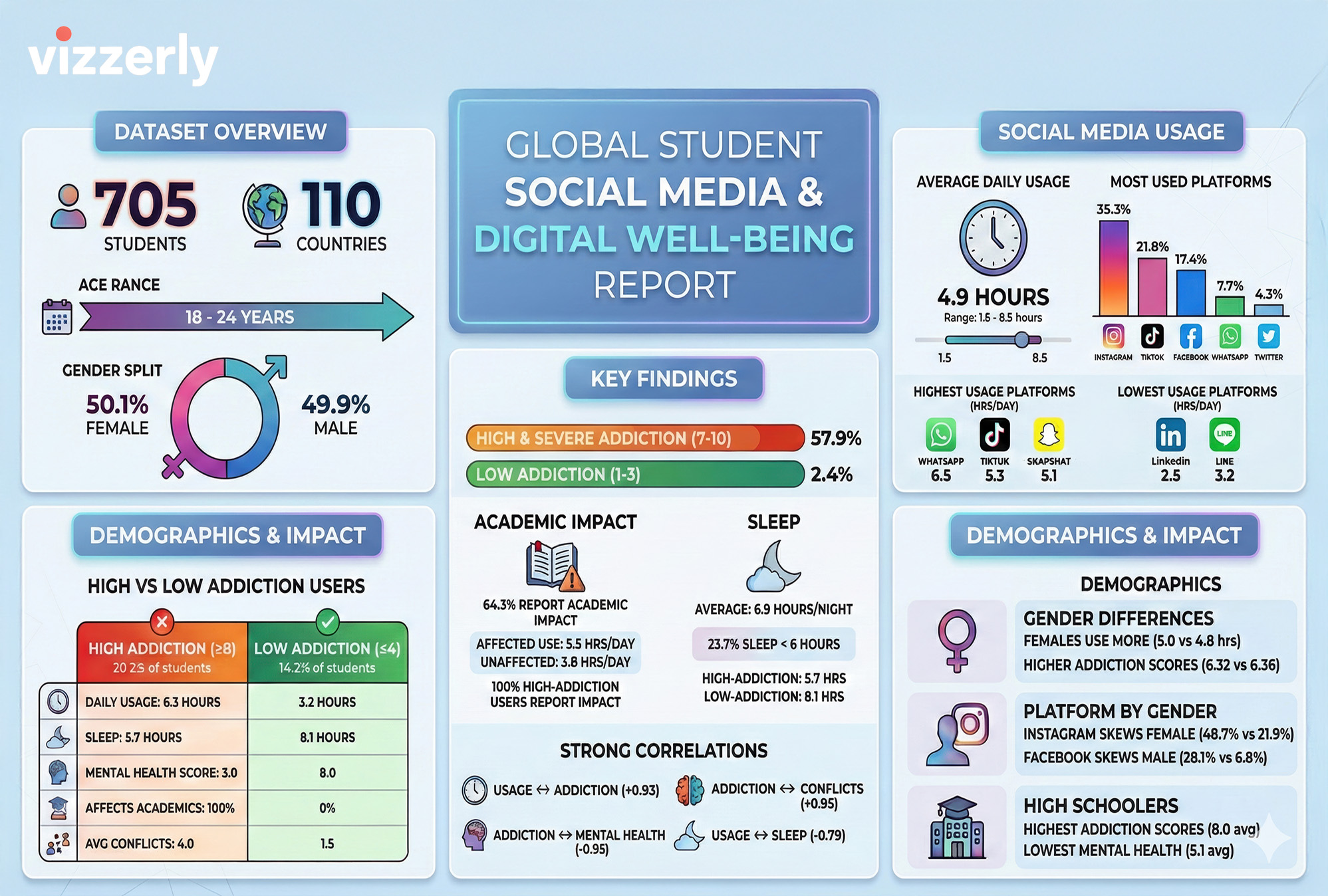
A new analysis of 705 students across 110 countries paints a troubling picture of social media’s grip on young people. The data reveal that the majority of students show signs of addiction, with cascading effects on sleep, mental health, academic performance, and personal relationships. As platforms compete for attention with increasingly sophisticated algorithms, students appear to be losing the battle for control of their own time.
The Scale of the Problem
The numbers are stark. More than half of the students surveyed, 50.1%, scored in the “high addiction” range of 7 or 8 on a 10-point scale. Another 7.8% fell into the “severe addiction” category with scores of 9 or higher. Combined, nearly 58% of students show significant signs of problematic social media use. Only 2.4% of respondents demonstrated low addiction levels, suggesting that healthy relationships with these platforms are the exception rather than the rule.
The average student in the study spends 4.9 hours per day on social media. To put that in perspective, that is more than a third of waking hours for someone who sleeps seven hours a night. Some students reported using up to 8.5 hours daily, leaving little time for studying, exercise, or face-to-face social interaction.
Instagram and TikTok Lead the Way
Not all platforms are created equal when it comes to capturing student attention. Instagram dominates, serving as the primary platform for 35.3% of students surveyed. TikTok follows at 21.8%, with Facebook at 17.4%. These three platforms alone account for nearly three-quarters of students’ primary social media use.
The data reveals essential differences in how these platforms affect users. WhatsApp users report the highest average daily usage at 6.5 hours, followed by TikTok at 5.3 hours and Snapchat at 5.1 hours. At the other end of the spectrum, LinkedIn users average just 2.5 hours of daily use and show the lowest addiction scores. This pattern suggests that platforms designed for professional networking may be inherently less addictive than those built around entertainment and social comparison.
TikTok and Snapchat users also report the lowest mental health scores and poorest sleep patterns among all platform users. TikTok users average just 6.4 hours of sleep per night, while Snapchat users get only 5.7 hours. The endless scroll of short-form video content appears to be particularly difficult for young people to disengage from, especially at night.
The Academic Toll
Perhaps the most concerning finding involves academic performance. A complete 64.3% of students report that social media negatively affects their studies. The difference between affected and unaffected students is dramatic. Those who say social media hurts their academics use an average of 5.5 hours per day, compared to 3.8 hours for those who report no impact.
The correlation becomes even clearer when examining addiction scores. Students who report academic problems have an average addiction score of 7.5, while those without academic concerns score just 4.6. Among students with addiction scores of 8 or higher, 100% report that social media affects their academic performance. Not a single highly addicted student claims to be unaffected.
High school students appear most vulnerable. Despite representing only 3.8% of the sample, they show the highest average addiction scores at 8.0 and the lowest mental health scores at 5.1. These younger students also get the least sleep, averaging just 5.5 hours per night. The data suggests that the earlier students develop heavy social media habits, the more severe the consequences.
Sleep and Mental Health Under Siege
The relationship between social media use and sleep is pronounced. Students in the study average 6.9 hours of sleep per night, falling short of the 8 to 10 hours recommended for this age group. Nearly a quarter of students (23.7%) sleep fewer than 6 hours nightly.
The contrast between high and low addiction users tells the story clearly. Those with addiction scores of 8 or higher sleep an average of 5.7 hours per night. Those with scores of 4 or lower get 8.1 hours. That difference of 2.4 hours per night adds up to nearly 17 hours of lost sleep per week for the most addicted students.
Mental health follows a similar pattern. The correlation between addiction scores and mental health scores is a striking negative 0.95, meaning they move in almost perfect opposition. As addiction rises, mental health falls. High addiction users report an average mental health score of just 5.0 on a 10-point scale, while low addiction users score 8.0. The highly addicted students are not just more tired; they are measurably less happy.
Relationships Suffer Too
Social media was designed to connect people, but the data suggests it may be doing the opposite. Students report an average of 2.8 social media-related conflicts on a 5-point scale, with 63.8% experiencing high levels (3 or more). The correlation between addiction and relationship conflicts is 0.93, nearly as strong as the link to mental health.
High addiction users report an average of 4.0 conflicts, compared to just 1.5 for low addiction users. The platforms that promise connection appear to be driving wedges between students and the people in their lives.
Conclusion
The data presents a clear picture of cause and effect. Students who use social media more become more addicted. Those who become more addicted sleep less, perform worse academically, experience more mental health problems, and have more conflicts in their relationships. The correlations are strong and consistent across the dataset.
What makes these findings particularly urgent is the near-universality of the problem. With fewer than 3% of students showing low addiction levels, problematic social media use has become the norm rather than the exception. The platforms have succeeded in capturing attention, but the cost to student well-being is increasingly difficult to ignore.
The question facing students, parents, educators, and policymakers is what to do with this information. The data does not offer easy solutions, but it does provide clarity about the stakes. For a generation of young people, the choice between scrolling and sleeping, between likes and learning, is not as simple as it might seem. The algorithms are winning, and the consequences are measured in lost sleep, lower grades, and diminished mental health.