For over a decade, Donald Trump’s presence on the platform now known as X served as one of the most consequential megaphones in American politics. From his early days as a reality TV star through his first term in the White House and now into his second, Trump has used the platform to praise allies, attack opponents, and shape political narratives. An analysis of more than 41,000 posts from May 2009 to January 2020 reveals clear patterns in who captured Trump’s attention—and who bore the brunt of his digital broadsides.
Obama: The Primary Target
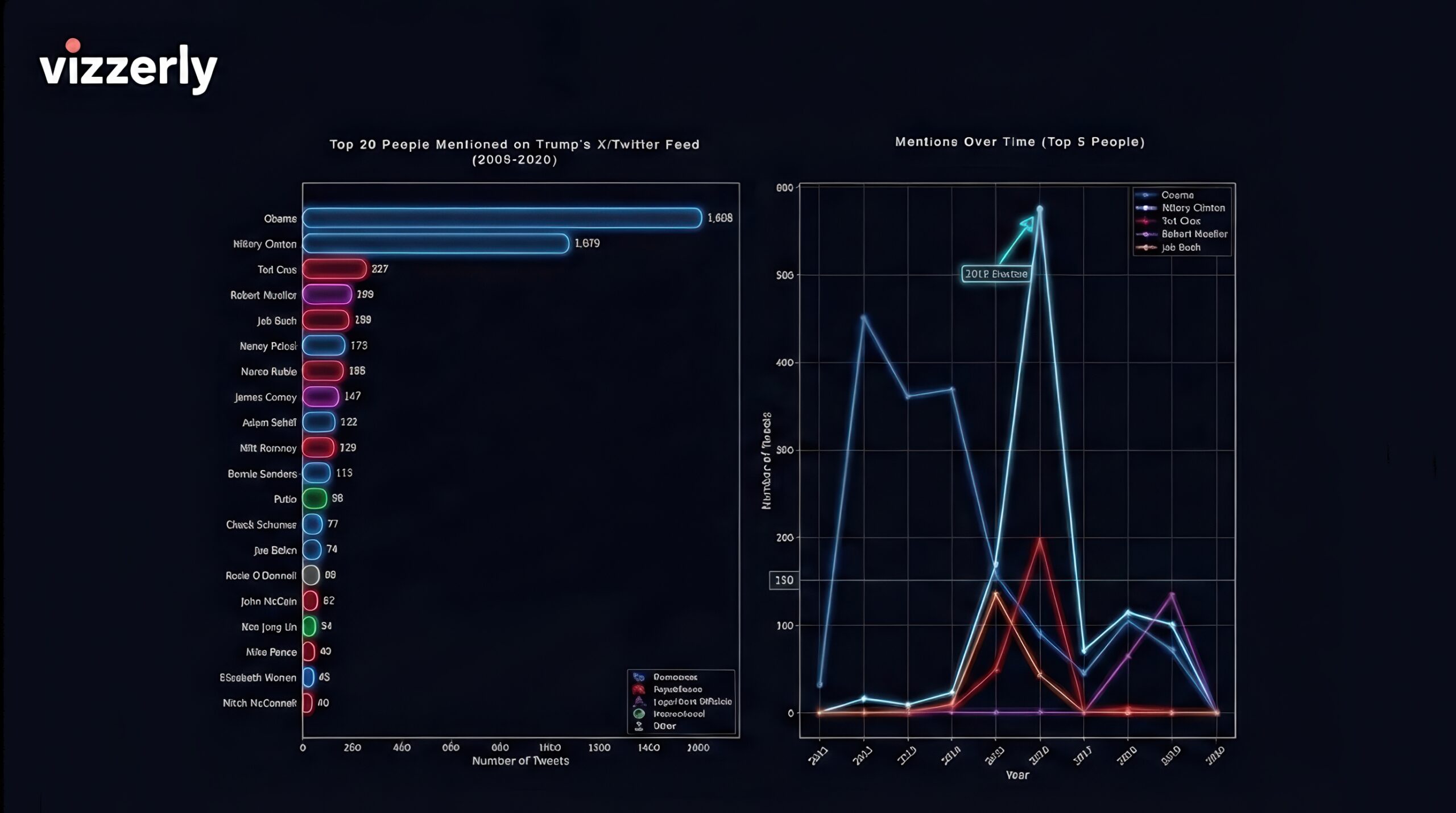
No figure loomed larger in Trump’s X universe than Barack Obama. The 44th president was mentioned in 1,683 posts—a staggering 4.1% of Trump’s entire output during this period. This fixation on Obama predates Trump’s political career and continued well into his first presidency.
The data tells a compelling story of escalation. Obama barely registered on Trump’s radar in 2009 and 2010, appearing in just one post during those early years. But by 2012, something shifted dramatically. That year alone, Trump mentioned Obama in 451 posts—roughly one every other day. This surge coincided with Trump’s embrace of the “birther” conspiracy theory and his increasing criticism of Obama’s policies.
The Obama mentions remained consistently high through 2014, with Trump regularly criticizing everything from healthcare policy to foreign affairs. Even after Trump assumed the presidency himself in 2017, Obama continued to appear in his posts, though at reduced frequency. The persistence of these mentions suggests that Obama served not merely as a political opponent but as a rhetorical foil against whom Trump defined his own political identity.
Hillary Clinton: The 2016 Phenomenon
If Obama represented a long-term preoccupation, Hillary Clinton embodied a more concentrated storm. Clinton appeared in 1,079 posts across the dataset, making her the second most-mentioned individual. However, the timing of these mentions reveals their true nature: Clinton was almost exclusively a 2016 phenomenon.
Before 2015, Clinton barely appeared in Trump’s posts at all. Then came the presidential campaign. In 2015, as both candidates launched their bids for the White House, Trump mentioned Clinton in 170 posts. The following year, that number exploded to 576—more than one mention per day throughout the entire election year.
The nicknames became infamous. “Crooked Hillary” entered the political lexicon as Trump hammered away at his opponent’s email controversy, her foundation, and her policy positions. This relentless focus demonstrated Trump’s understanding of social media as a campaign weapon—a tool for defining opponents before they could define themselves.
What’s perhaps most striking is the persistence of Clinton mentions even after the election. In 2017 and 2018, Trump continued to reference his defeated opponent in more than 180 additional posts, suggesting that Clinton remained a valid political target long after she posed any electoral threat.
The Primary Wars: Cruz, Bush, and Rubio
The 2016 Republican primary left unmistakable fingerprints in the data. Ted Cruz (257 mentions), Jeb Bush (189 mentions), and Marco Rubio (166 mentions) all ranked among Trump’s most-referenced figures, with their mentions concentrated almost entirely in 2015 and 2016.
Jeb Bush drew particular attention in 2015, when 135 of his 189 total mentions occurred. Trump’s dismissal of Bush as “low energy” became one of the campaign’s defining moments, and the data confirms that Bush was Trump’s primary Republican target in the early stages of the race.
As Bush’s campaign faded, Cruz emerged as the primary challenger—and the primary target. In 2016, Trump mentioned Cruz in 197 posts, deploying nicknames like “Lyin’ Ted” with characteristic repetition. Rubio, too, faced a barrage during his brief moment as a serious contender.
The sharp drop-off in mentions after the primary ended demonstrates the transactional nature of Trump’s targeting. Once these figures no longer posed a political threat, they largely disappeared from his feed.
The Mueller Era
Robert Mueller’s appearance in the data illustrates how Trump’s targets evolved as circumstances changed. The special counsel doesn’t appear at all until 2018, when the Russia investigation intensified. That year, Mueller was mentioned in 65 posts. In 2019, as the investigation concluded and its aftermath played out, that number doubled to 134.
James Comey followed a similar pattern. The FBI director appeared in 147 posts, with mentions clustering around his 2017 firing and his subsequent public testimony. Other investigation-related figures—Andrew McCabe, Rod Rosenstein, and Adam Schiff—also emerged as frequent targets during this period, demonstrating how the Mueller investigation reshaped Trump’s social media priorities.
Patterns and Implications
Several broader patterns emerge from this analysis. First, Democrats dramatically outnumbered Republicans among the figures most often mentioned by Trump. The top two spots belonged to Obama and Clinton, while Nancy Pelosi, Chuck Schumer, Bernie Sanders, and Adam Schiff all appeared prominently. This suggests that Trump’s social media strategy centered on energizing his base through attacks on the political opposition rather than promoting Republican allies.
Second, the data reveals Trump’s account as fundamentally reactive and tactical. Mentions spiked in response to specific political moments—the 2016 campaign, the Mueller investigation, and impeachment proceedings. Figures rose and fell in prominence based on their immediate relevance to Trump’s political situation.
Third, the sheer concentration of attention on a small number of figures is remarkable. Obama and Clinton alone accounted for nearly 7% of all posts analyzed. Adding the following eight most-mentioned individuals brings that figure to roughly 10%. In a decade of posting, a handful of people dominated Trump’s attention.
Conclusion
Trump’s account on the platform, then known as Twitter, was suspended in January 2021 following the Capitol riot, but the story didn’t end there. After Elon Musk acquired the platform and rebranded it as X in 2022, he reinstated Trump’s account that November. Though Trump largely favored his own platform, Truth Social, during the intervening years, his return to the White House in January 2025 raises questions about whether the patterns revealed in this data will reemerge on X.
The strategies uncovered here—the fixation on opponents, the tactical deployment of nicknames, the reactive surges in attention—became defining features of the Trump era and reshaped expectations for how politicians communicate online. Now that Trump is once again president, this historical data offers valuable insight into how he has used social media in the past and may use it again. The numbers make one thing clear: on social media, Donald Trump knows exactly who his targets are, and he never lets them forget it.